
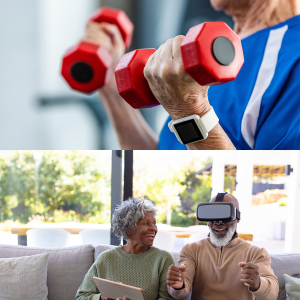
 Overview: The last decade has seen remarkable growth in the wearable technologies sector, including devices for health and activity tracking and monitoring. While smart watches including the Apple Watch, FitBit and Samsung Galaxy Watch remain the most prominent category of devices among consumers, new classes of commercial and research devices are emerging including earables (smart in-ear devices), smart rings, and more. These wearable devices typically pair physiological and activity sensing capabilities with AI and machine learning based data analytics to produce a variety of outputs from heart rate and blood pressure to step counts and activity classification. Augmented and virtual reality (AR/VR) devices, including smart glasses and headsets, have also made significant advances over the last decade, including consumer-focused offerings from Meta and Apple. AR/VR offers interesting possibilities for social interaction, physical exercise, rehabilitation, cognitive exercise and cognitive assessment.

Vascular aging using infrasonic hemodynography embedded into everyday earbuds
Anna Barnacka, MindMics Inc. The MindMics pilot project explored the use of infrasonic hemodynography (IH) technology embedded in everyday wireless earbuds to monitor cardiovascular health and assess vascular aging.

Validating the Apple Watch for Passive Monitoring of Agitation in Patients with Dementia
James Mastrianni, The University of Chicago. Josh Kim, Adiona Health. This project seeks to validate a novel machine learning technique that analyzes motion data from an accelerometer in an Apple Watch to identify the onset of an agitation episode in a person with ADRD.
In-home Cognitive Improvement Training using EEG-NFB
Robert Hager, Preveal Technologies, Inc. Hassan Ghasemzadeh, ASU. The Preveal pilot project focused on developing an in-home cognitive improvement system using EEG-based neurofeedback (EEG-NFB) to monitor and enhance working memory in older adults.

Correlations Between Light Exposure Inputs and Sleep Quality Outputs
Erik Page, Blue Iris. The Blue Iris Labs pilot study investigated how personal light exposure affects sleep quality using a new wearable light sensor called the Speck.

Expanding a Multimodal VR Fitness Platform to Remotely Assess, Monitor, and Report Cognitive and Physical Function for Seniors
Jennifer Stamps and Kyle Rand, Rendever, Inc. This pilot study will evaluate the utility of RendeverFit™, a VR fitness platform, in terms of its acceptance by and relevance to older adults, as well as collect data to support the construction of machine learning models.
Preventing falls before they occur: validating a wearable sensor for Orthostatic Vital Signs
Amar Basu, Wayne State University, Michael Busa, UMass Amherst. This project will evaluate TRACE, a novel wearable sensor for monitoring orthostatic vital signs continuously at home, whenever an individual stands up.

AI-Supported In-Home Brain Assessments for Older Adults and Persons with Alzheimer’s Disease
Quan Zhang, Massachusetts General Hospital. This project will create an adapted version of NINscan, a Near-Infrared Neuromonitoring Device, with the goal of enabling older adults and AD patients to collect high quality brain and physiological data at home.

An academic-industrial partnership for AI-based sleep staging in the elderly using an EEG headband and a smartwatch
Joyita Dutta, UMass Amherst. This project will develop AI techniques for at-home sleep staging in seniors using multimodal data from EEG headband and smartwatch devices.

Accelerating Balance Recovery Using Adaptive EVS Therapy
John Ralston, Neursantys Inc. VP Nguyen, UMass Amherst. This project will develop ML-driven methods to adapt EVS stimulus parameters to each patient’s unique sensory and motor impairment profile to increase the effectiveness of NEURVESTA’s current treatment protocol.

Measuring Heart Rate using Biomagnetism-based Wearable Devices
Longfei Shangguan, University of Pittsburgh. This project will aim to develop an innovative wearable system that leverages biomagnetism to deliver more accurate heart rate and respiration monitoring across diverse skin tones.

AI-Driven Earpiece Wearable to Enhance Symptom Management, Self-Care, and Caregiver Support in AD/ADRD Patients
Selina Zhu, Lumia Health. Paolo Bonato, Spaulding Rehabilitation Hospital. This pilot will test the Lumia ear wearable in people with Alzheimer’s disease and related dementias (AD/ADRD), allowing users to track blood flow to the head and report symptoms through a voice-controlled AI assistant. The study will focus on usability and adapting Lumia’s technology for older adults with cognitive impairments.

Wearable Heart Failure Socks for Exacerbation and Treatment Monitoring
Pamela Z. Cacchione, University of Pennsylvania. Li Shen, University of Pennsylvania. Heart Failure Monitoring Socks will be used in hospitalized persons with heart failure to gather data on heart failure exacerbations and responses to treatment. We will use this data to develop predictive models for edema and fatigue due to heart failure.

Past Webinar – Listening to the Heart: In-Ear Infrasonic Technology for Blood Pressure and Beyond
Abstract: This talk will highlight the results of MindMics’ recent feasibility study on non-invasive blood pressure monitoring using in-ear infrasonic signals. Dr. Barnacka will discuss how this novel technology, validated through clinical research, can be integrated into both consumer earbuds and hearing aids, creating a new class of connected health devices. The presentation will explore the underlying infrasonic science, algorithmic advances, and the broader impact on cardiovascular health, preventive care, and data-driven wellness ecosystems. Biography:

Past Webinar – No One Left Behind: Building Low-Cost Wearables for Low-Income Communities, Longfei Shangguan
Abstract: Wearable devices such as Apple Watch and Fitbit wristband allow users to track their health statistics around the clock. They have become increasingly popular over the past few years. However, in the context of low-income areas of United States, these wearable devices are still pricey and thus constitute a critical bottleneck in their adoption. In this talk, I will present our past and ongoing works on repurposing electronic wastes, particularly everyday earphones into health trackers – from heart rate monitoring, heart sound recovery, all the way down to pulse wave velocity estimation in home settings. I will also discuss the potential of these technologies for filling the gap of remote health care. I believe this research creates a holistic approach toward recycling and repurposing electronic waste while fostering a

Past Webinar – Intelligent Mobile Systems for an Aging World, Justin Chan (September 23, 2025 @4pm ET)
Abstract: By 2050, older adults will make up about 22% of the global population, driving an urgent need for accessible and reliable health technologies. In this talk, I will present our work on intelligent mobile systems designed for older adults. The first enables low-cost health screening using everyday earphones and wireless earbuds. The second is an ambient sensing system that uses smart devices to detect emergent, life-threatening events such as cardiac arrest. The third leverages compact AI-enabled radios for cardiovascular monitoring, including blood pressure. Through these examples, I will show how computational and sensing techniques that generalize across hardware and operate in real-world environments can address pressing societal challenges. Biography:

Past Webinar – The Impact of Light Exposure on Sleep: A Pilot Study, Erik Page (Blue Iris Labs)
Abstract: Light exposure is the primary regulator of human circadian rhythms, influencing many aspects of our physiology and behavior, including sleep, alertness, and mood, as well as many neuroendocrine and cognitive functions. While we have evolved experiencing “bright days and dark nights,” most of us now experience significantly darker days and brighter nights than our pre-modern ancestors, likely resulting in widespread circadian disruption. And as we age, the relationship between light exposure, circadian rhythms, and sleep can be further compromised both through normal aging (e.g., less light reaching the retina due to clouding of the lens) and age-related risk factors, such as Alzheimer’s Disease (AD), which is known to damage the brain’s master clock. This webinar will review the current science related to light exposure, circadian rhythms, and sleep, looking

Past Webinar – Comprehending Human Behaviors using Wireless Sensing on Everyday Wearables, Cheng Zhang
Abstract: Despite the rapid advancement of AI, computers’ ability to comprehend human behaviors remains limited. For instance, commodity computing devices still face challenges in understanding even basic human daily activities such as eating and drinking. The primary obstacle lies in the absence of suitable sensing technologies capable of capturing and interpreting high-quality behavioral data in everyday settings. In this presentation, I will share my research on the development of everyday wearables that are minimally-obtrusive, privacy-aware, and low-power, yet capable of capturing and comprehending various body movements and poses that humans employ in their everyday activities. First, I will show how these sensing technologies can empower various everyday wearable form factors, including wristbands, necklaces, earphones, headphones, and glasses, to track essential body postures, such as facial expressions, gaze, finger poses, limb

Past Webinar – Sustainable Ear-Worn Systems for HCI and BCI: Design, Development, and Deployment, VP Nguyen
Abstract: This talk introduces curiosity-driven research that explores science and technology to build the next generation of ear-worn computer systems that are robust, sustainable, cost-effective, low-burden, and socially acceptable, thereby unlocking new applications in human-computer interaction and brain-computer interface. Yet, the development of these systems brings significant challenges, demanding a rethinking of hardware and software frameworks, advanced ML algorithms, and significant interdisciplinary efforts. I will present our approaches to fill the gaps and build practical ear-worn computers, highlighted by motivating applications our lab has worked on: interactive computing and disease monitoring and intervention. Additionally, I will share insights gained from deploying these systems in various real-world settings and discuss future research directions. Biography:
Webinar – Technology for Enhancing Functional Health: Monitoring Movement with Wearables and Sensors, Margie Lachman, Amanda Paluch, Jen Blankenship
Abstract: Nearly half of adults over 75 experience functional limitations, often worsened by physical inactivity and sedentary behavior. There is an inherent need for innovative technologies—such as wearables, sensors, and AI systems—to detect early declines and support timely interventions that maintain independence and quality of life. This webinar explored potential innovative approaches that are being developed through the support of the MassAITC pilot program to support functional health and independence among older adults through wearable and ambient sensor technologies. Dr. Amanda Paluch (University of Massachusetts) presented her pilot study on detecting frailty in home environments using non-invasive, whole-room body heat sensors (Butlr Care). Her team’s interdisciplinary work aims to develop low-burden, contactless algorithms capable of continuously monitoring movement patterns to detect early signs of frailty and support interventions that promote

MassAITC Webinar – Opportunities and Challenges in Automatic Detection of Momentary Stress via Wearables, Santosh Kumar
Talk Abstract: Stress, a double-edged sword, has been long recognized for its potential to fuel productivity, enhance performance, and provide life-saving bursts of energy in times of imminent danger. Excessive and repetitive stress, however, can harm our physiological, psychological, behavioral, and social well-being. Due to its wide prevalence and impact in our lives, stress detection is increasingly being introduced in smartwatches, rings, and other wearables to help us become aware of and mitigate excessive stress. But unlike activity tracking, stress detection is yet to be adopted widely. What makes real-life stress detection so challenging? What progress has been made thus far and what else needs to be done to make stress detection truly useful? About the Speaker: Santosh Kumar is the Lillian & Morrie Moss Chair of Excellence Professor in

MassAITC Webinar – Wearable Acoustic and Vibration Sensing and Machine Learning for Human Health and Performance, Omer Inan
This talk will focus on: Abstract: Recent advances in digital health technologies are enabling biomedical researchers to reframe health optimization and disease treatment in a patient-specific, personalized manner. This talk will focus on my group’s research in two areas of relevance to digital health: (1) cardiogenic vibration sensing and analytics; and (2) musculoskeletal sensing with joint acoustic emissions and bioimpedance. Our group has extensively studied the timings and characteristics of cardiogenic vibration signals such as the ballistocardiogram and seismocardiogram, and applied these signals for cuffless blood pressure measurement, heart failure monitoring, and human performance. We have also leveraged miniature contact microphones to measure the sounds emitted by joints, such as the knees, in the context of movement, and have examined how these acoustic characteristics are altered by musculoskeletal injuries and