
Investigators:
Amar Basu, TRACE Biometrics
Michael Busa, UMass Amherst.
MassAITC Cohort: Year 2 (Aging)
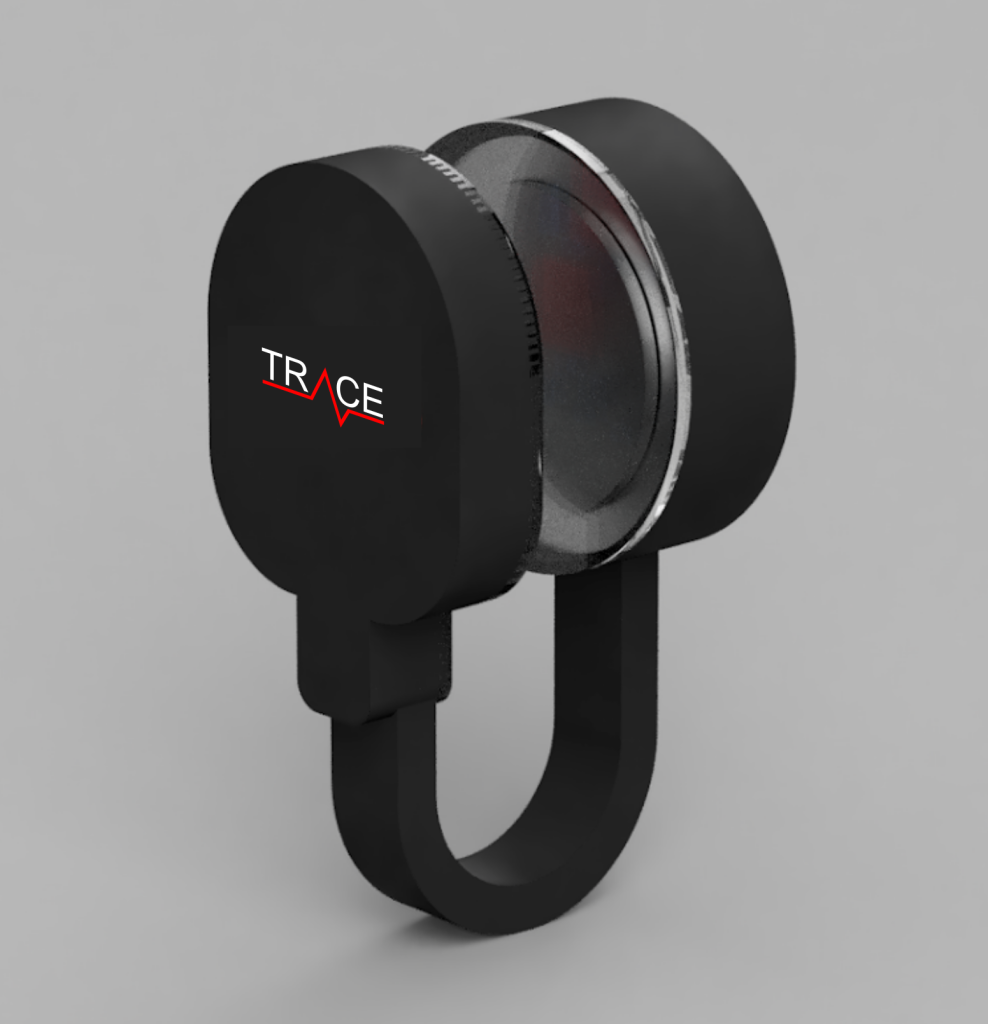
Project Accomplishments: The project encompassed three parallel tracks: wearable device development, a clinical validation study, and regulatory/commercialization planning. TRACE Biometrics developed and iteratively refined the Gen 2 TRACE wearable sensor, which measures extracranial blood volume, heart rate, hemodynamic parameters, motion/posture, skin temperature, and SpO2. The project had three aims: evaluating TRACE’s ability to automatically detect stand-up events and extract orthostatic vital sign metrics during an 8-hour day (Aim 1), creating clinical diagnostic guidelines for interpreting diurnal OVS data (Aim 2), and completing the FDA pre-submission process (Aim 3). A total of 21 participants completed the full 8-hour protocol at UMass Amherst’s Living Science Lab.
The study demonstrated that TRACE can be worn continuously to obtain physiologic data over a full day, with stand-up event detection achieving up to 85% sensitivity and 91% precision in the best cases, though consistency across participants requires further refinement. A significant clinical finding was that orthostatic responses are not static within a single day—factors including meals, hydration, and rest influenced responses—challenging the current clinical standard of single-point-in-time testing. Data from an independent TRACE study showed that TRACE metrics were more predictive of orthostatic symptoms than conventional blood pressure monitoring, presented in two papers accepted at IEEE BSN 2024. Key achievements include successful Gen 2 sensor development and deployment, battery life extension to over 6 hours, development of data analysis infrastructure, winning the poster pitch competition at the 2024 NIA A2 Symposium, and a strategic decision (based on FDA consultation) to skip the pre-submission process in favor of proceeding directly with a 510(k) submission.
Initial Proposal Abstract: Orthostatic hypotension (OH), a drop in blood pressure (BP) upon standing, affects nearly 1 in 3 older adults and increases the risk of falls by 2.5X. As a result, major medical organizations recommend monitoring orthostatic vital signs (OVS) in individuals experiencing symptoms of OH. Despite the clinical need, current OVS screening technologies remain limited.
The consensus definition of OH is a drop in systolic BP of at least 20 mm Hg within 3 minutes of standing, measured by a BP cuff. This method fails to capture the complex responses (increased heart rate, cardiac output, vasoconstriction) that occur immediately upon standing. Thus, it may miss conditions such as initial orthostatic hypotension (IOH) and delayed BP recovery. Furthermore, OH has diurnal variation due to bedrest, meals, and hydration state; thus, infrequent ‘snapshots’ may miss warning signs or key trends.
This project will evaluate TRACE, a novel wearable sensor for monitoring OVS continuously at home, whenever an individual stands up. Our long-term goal is to enable physicians to perform remote monitoring of OVS. The objective of this project is to gather pre-clinical data that validates the efficacy of TRACE in a home-like setting. Evaluations will be performed at the UMass Amherst Center for Human Health and Performance (CH2P), a home-like setting designed to validate patient monitoring devices. TRACE OVS signals and extracted metrics will be compared to industry standard BP cuffs, ECG, and pulse oximeters.
If successful, TRACE could enable a new paradigm in OH management that assesses how symptoms change over timescales of hours to weeks. Understanding such trends would enable clinicians to guide personalized, evidence-based interventions to reduce fall risk and other co-morbidities.
Outcomes:
- Grant Funding: Novel orthostatic vital signs measured by an earlobe wearable device (1R21AG088945)
 Principal investigator, Amar Basu, professor of electrical and computer engineering at Wayne State University and CEO of TRACE Biometrics LLC, has received a National Institute on Aging R21 award to further validate the TRACE sensor against gold standard clinical orthostatic measures, which will build upon the pilot award’s work towards… Read more: Grant Funding: Novel orthostatic vital signs measured by an earlobe wearable device (1R21AG088945)
 - Publication: Predicting Orthostatic Symptoms Using a Multiparameter Wearable Sensor
 Authors: Ziad A Elhajjaji, Amar S Basu Abstract Orthostatic disorders affect 30% of older adults and increase the risk for falls. The current diagnostic standard, the blood pressure cuff, cannot capture the rapid, multifaceted dynamics of orthostasis physiology, resulting in frequent underdiagnosis. This paper demonstrates multiparameter, real-time measurement of orthostasis… Read more: Publication: Predicting Orthostatic Symptoms Using a Multiparameter Wearable Sensor
 - Poster Presentation: a2 National Symposium 2024
 Title: Validating an AI-enhanced remote patient monitoring platform for orthostatic vital signs Authors: Amar Basu & Michael Busa
 - Award: Winner of Poster Pitch Competition at 2024 a2 Symposium
 Source: https://www.linkedin.com/posts/amarbasu_remotepatientmonitoring-agetech-wearables-activity-7178610115787304960-7aWy?utm_source=share&utm_medium=member_desktop
 - New Product Version Launch: TRACE sensor
 TRACE Biometrics has developed a 2nd generation TRACE sensor, a cross platform app for data collection, and designed a compact charger for TRACE. The new devices are 40% smaller than Gen 1, have improved signal processing, better wireless transmission, and are more configurable.
 - Company Launch: Trace Biometrics
 About TRACE Biometrics was formed to commercialize their wearable OVS Platform. TRACE Biometrics provides a remote patient monitoring solution that empowers clinicians and caregivers to better manage orthostatic hypotension, a condition that affects 1 in 3 older adults and poses a significant risk for fall-related injuries. Their patented wearable device… Read more: Company Launch: Trace Biometrics
 - Publication: Assessing Novel Orthostatic Vital Signs with a Wearable SensorAuthors: Ziad A. Elhajjaji, Amar S. Basu Abstract Orthostatic hypotension (OH) is a reduction in blood pressure and cerebral blood flow upon standing. Presenting in nearly 30% of older adults, OH is associated with increased fall risk and other co-morbidities. The clinical standard for monitoring OH, a blood pressure (BP)… Read more: Publication: Assessing Novel Orthostatic Vital Signs with a Wearable Sensor