
Investigators:
Joyita Dutta, UMass Amherst
MassAITC Cohort: Year 2 (AD/ADRD)
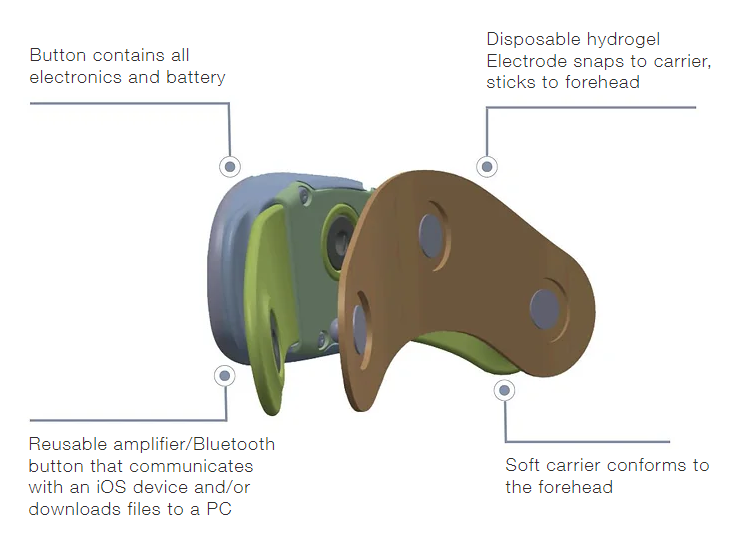
Project Accomplishments: Through an academic-industrial partnership between UMass Amherst and CGX Inc., this project focused on developing AI-based sleep staging for elderly populations using a CGX EEG headband and an Apple Watch. The project collected concurrent sleep data from 50 adults aged 65 and older (including 20 with at least two Alzheimer’s disease risk factors) using FDA-cleared polysomnography (PSG) as the gold standard alongside wearable devices over 7-night monitoring periods. The three aims were to benchmark wearable device sleep staging performance against PSG, develop a transfer learning framework for improved EEG-based sleep staging, and create a multimodal AI model combining EEG and smartwatch data for more robust sleep characterization in older adults.
The results demonstrated that the Apple Watch achieved 63.5% sleep staging accuracy compared to PSG, while a transfer learning framework improved the CGX headband’s accuracy from 56% to 68%. The multimodal AI model combining both devices achieved 70% accuracy and reduced estimation errors across key sleep metrics by up to 50% compared to single-device approaches, demonstrating the value of multi-sensor fusion for sleep assessment in aging populations. Key project outputs include a peer-reviewed publication in IEEE Transactions on Biomedical Engineering, the release of the BIDSleep mobile application on the Apple App Store for sleep data collection, and plans to share a de-identified dataset on the PhysioNet repository as a public digital health resource for advancing sleep research and AI model development in senior populations.
Initial Proposal Abstract: This academic-industrial partnership between UMass Amherst and CGX Systems will develop AI techniques for sleep staging in seniors (>65 years) using multimodal data from two wearable devices. We will validate a wearable EEG headband and a smartwatch for sleep staging and characterization in the elderly. Sleep disturbances are among the earliest observable symptoms of Alzheimer’s disease (AD). While many wearables are available for sleep monitoring, most studies are based on young subjects. Our work will impact early identification of seniors at risk of AD, opening up a large elderly market for wearable devices like EEG headbands and smartwatches.
Outcomes:
- Publication: AI-Driven Sleep Staging Using Instantaneous Heart Rate and Accelerometry: Insights from an Apple Watch Study
 Authors: Tzu-An Song, Yubo Zhang, Ziyuan Zhou, Luke Hou, Masoud Malekzadeh, Aida Behzad, Joyita Dutta Abstract Polysomnography, the gold standard for sleep evaluations, involves complex setup and data acquisition protocols and requires manual scoring of sleep data. Smartwatches and other multi-sensor consumer wearable devices with automated sleep staging capabilities offer… Read more: Publication: AI-Driven Sleep Staging Using Instantaneous Heart Rate and Accelerometry: Insights from an Apple Watch Study
 - New Product Launch: BIDSleep iPhone and Apple Watch App
 BIDSleep helps you access wellness data from your Apple Watch, including heart rate, motion, blood oxygen, and sleep stages, all securely stored on your device. App Purpose: BIDSleep is a wellness app that helps users collect heart rate, blood oxygen (SpO₂), motion, and optional sleep stage data during rest or… Read more: New Product Launch: BIDSleep iPhone and Apple Watch App
 - Open Source AI-model Released: SLAMSS-IFS
 To the study team’s knowledge, this is the first open-source four-class sleep staging model developed from a multi-night Apple Watch sleepstudy. SLAMSS-IFS, an advanced version of our previous SLAMSS model, for four-class sleep staging using IHR and accelerometry signals fromthese wearable devices. Key innovations in the model, including an intra-epoch… Read more: Open Source AI-model Released: SLAMSS-IFS
 - Grant Funding: R01 AG082354
 Title: Genomics-guided sleep biomarker discovery for early Alzheimer’s disease: A wearables study This R01 builds upon the technology and algorithms for sleep-based metrics developed in the MassAITC pilot project, utilizing the same EEG device. It shifts the study from a general AD-risk factor population to a genetic AD-risk factor population.… Read more: Grant Funding: R01 AG082354