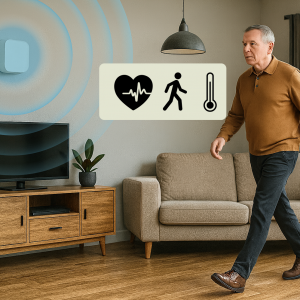
 Overview: Wearable sensing refers to sensing technologies incorporated into devices like smart watches and smart rings that are worn on the body. By contrast, remote sensing refers to sensing technologies that are placed in the built environment such as vibration sensors, microphones, visible light cameras, infrared cameras, millimeter wave radar, and other forms of radio frequency-based sensing. Remote sensing technologies deployed in the home environment can be used for a variety of health-relevant applications from monitoring activities of daily living to collecting vital signs like heart rate. While wearables have an advantage over remote sensing approaches in that they can provide more ubiquitous monitoring, remote sensing technologies have the advantage that they are lower burden as users do not need to remember to wear or carry a device.

Contactless Cardiovascular Health Monitoring for AD using an AI-Enhanced mmWave Radar
Justin Chan, Carnegie Mellon University. Swarun Kumar, Carnegie Mellon University. Neelesh Nadkarni, University of Pittsburgh. The proposed work uniquely aims to measure pulse transit time and blood pressure across different arterial points across the body using the reflections of wireless signals from a single AI-enabled mmWave radar device, which is a key enabler towards whole-body blood flow monitoring both in home and clinical environments.

Behavioral Analytics is the New Medical Device
Rhoda Au, Boston University, Laura McIntosh, EmPowerYu. This project will use in-home multimodal sensors to detect changes in daily life activity patterns that indicate fluctuations in cognitive status.

An Objective Assessment Tool for Evaluating Functioning in Older Adults
Ehsan Adeli, Victor W. Henderson, Stanford University. The proposed project aims to design a mobile app that not only instructs and records individuals performing Short Physical Performance Battery (SPPB) tests but also uses these data for predictive analysis to monitor and quantify the risk of cognitive impairment over time, utilizing video data analyzed for motor-cognitive relationships.

Towards an AI-based Care Plan for ADRD Caregiver-patient Dyads
G. Antonio Sosa-Pascual, REOFTech. Michael Busa, UMass Amherst. This project aims to collect data from wearables and smart home sensors to determine the state, rate, and direction of change in dementia patient agitation and caregiver well-being.

Chronic Pain Monitoring and Assessment for LTC Residents with ADRD by AI Sensing
Xian Du, Joohyun Chung, UMass Amherst. Shishir Prasad, BD.
In this project, we will develop the approach for the continuous monitoring of long-term care (LTC) resident’s behavioral and physiological signals over extended durations using cameras and wearable sensors.

Detection of falls and other health events using sound, activity monitoring and machine learning
Richard Watkins, Livindi. The Livindi pilot project aimed to develop and test a technology platform that detects distress-related events—especially falls—using audio recognition, motion sensors, and machine learning. Participants received pre-configured kits with tablets and sensors, and the system was designed to operate entirely on-device to ensure privacy.

Decreasing Risk of Falls via Computer Vision & AI Driven Functional Assessments
Dave Keeley, Electronic Caregiver, Inc. Michael Busa, UMass Amherst. This research project will enhance Electronic Caregiver’s Addison Care system with computer vision methods for evaluating functional strength, stability, and falls risk in older adults.

Validating a Remote Sensor for Continuous Health Monitoring of Older Adults to Support Aging in Place and AD/ADRD Care Management
Ryan Gooch, TellUs You Care. Rebecca Spencer, UMass Amherst. This study will test Tellus’s machine learning algorithms for tracking physiological and behavioral status using data from Tellus’ radar device.

Early acute illness detection in delirium and dementia
Jane Saczynski, Northeastern University. Edward Marcantonio, Beth Israel Deaconess Medical Center. Acute illness presents in the most vulnerable organ in the body, among patients with dementia that organ is the brain and acute illness often presents first as delirium, an acute confusional state. This project will evaluate home monitoring devices as early indicators of acute illness in persons with dementia.

Detecting frailty in home environments through non-invasive whole room body heat sensing in older adults
Amanda Paluch, UMass Amherst. Dae Hyun Kim, Hebrew SeniorLife. Rags Gupta, Butlr Technologies Inc. This AITC pilot project explored the use of non-invasive, ceiling-mounted heat sensors to detect frailty in older adults living in senior communities.

Past Webinar – Intelligent Mobile Systems for an Aging World, Justin Chan (September 23, 2025 @4pm ET)
Abstract: By 2050, older adults will make up about 22% of the global population, driving an urgent need for accessible and reliable health technologies. In this talk, I will present our work on intelligent mobile systems designed for older adults. The first enables low-cost health screening using everyday earphones and wireless earbuds. The second is an ambient sensing system that uses smart devices to detect emergent, life-threatening events such as cardiac arrest. The third leverages compact AI-enabled radios for cardiovascular monitoring, including blood pressure. Through these examples, I will show how computational and sensing techniques that generalize across hardware and operate in real-world environments can address pressing societal challenges. Biography:

Webinar – Technology for Enhancing Functional Health: Monitoring Movement with Wearables and Sensors, Margie Lachman, Amanda Paluch, Jen Blankenship
Abstract: Nearly half of adults over 75 experience functional limitations, often worsened by physical inactivity and sedentary behavior. There is an inherent need for innovative technologies—such as wearables, sensors, and AI systems—to detect early declines and support timely interventions that maintain independence and quality of life. This webinar explored potential innovative approaches that are being developed through the support of the MassAITC pilot program to support functional health and independence among older adults through wearable and ambient sensor technologies. Dr. Amanda Paluch (University of Massachusetts) presented her pilot study on detecting frailty in home environments using non-invasive, whole-room body heat sensors (Butlr Care). Her team’s interdisciplinary work aims to develop low-burden, contactless algorithms capable of continuously monitoring movement patterns to detect early signs of frailty and support interventions that promote