Abstract
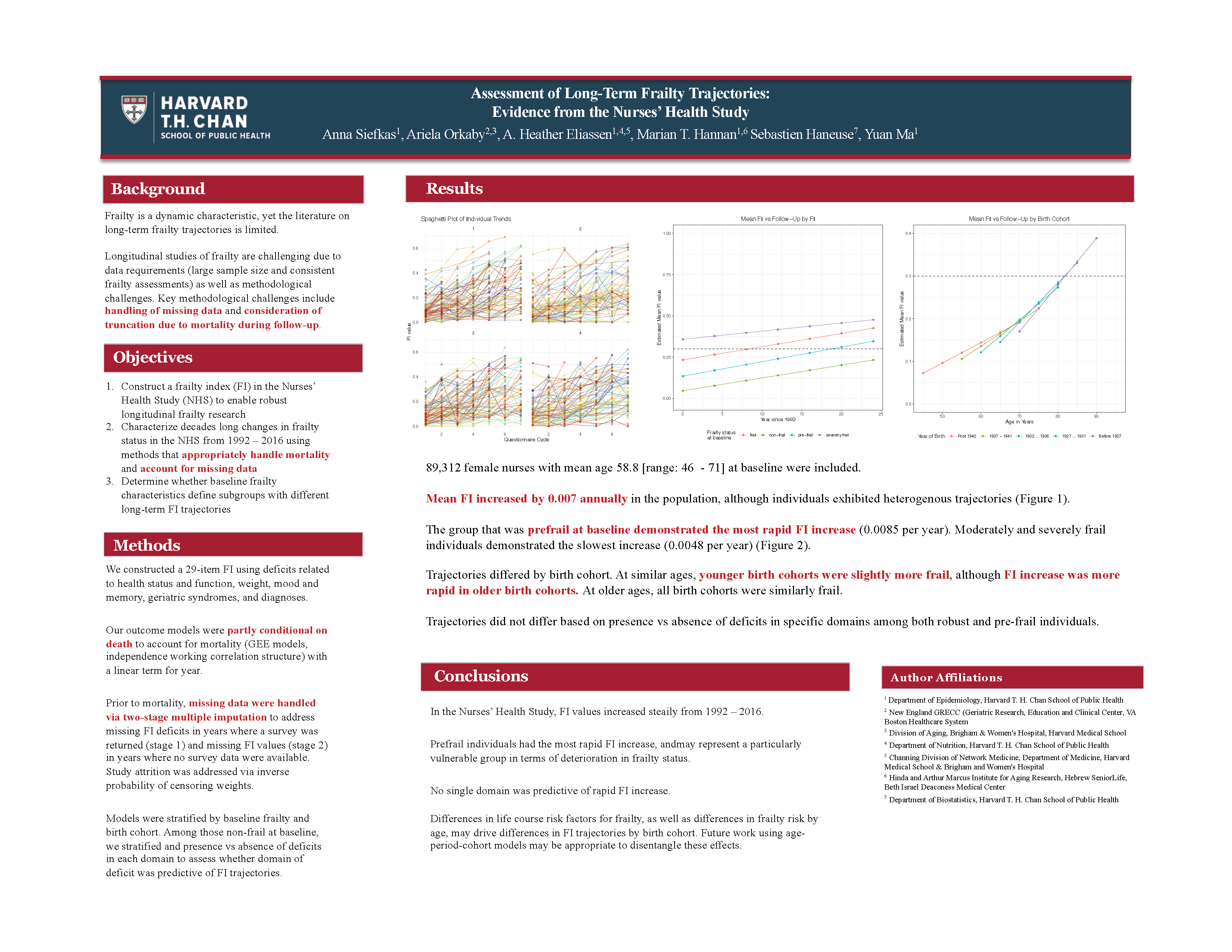
Evidence on long-term frailty trajectories may better inform prognosis than single-time measurements. However, such evidence is limited by methodological challenges including missing data, study dropout, and truncation due to mortality. We characterized long-term frailty trajectories of 89,312 women. A frailty index (FI) was calculated every four years, using two-stage multiple imputation to impute FI item non-response in years with available data (stage 1) and complete FI values in years of unit non-response (stage 2). We addressed attrition using inverse probability of censoring weighting. Models for frailty were estimated partly conditional on death to avoid implicit imputation of trajectories past the point of mortality. Trajectories differed by baseline frailty status and by birth cohort, but not by specific FI deficits present at baseline.