Abstract
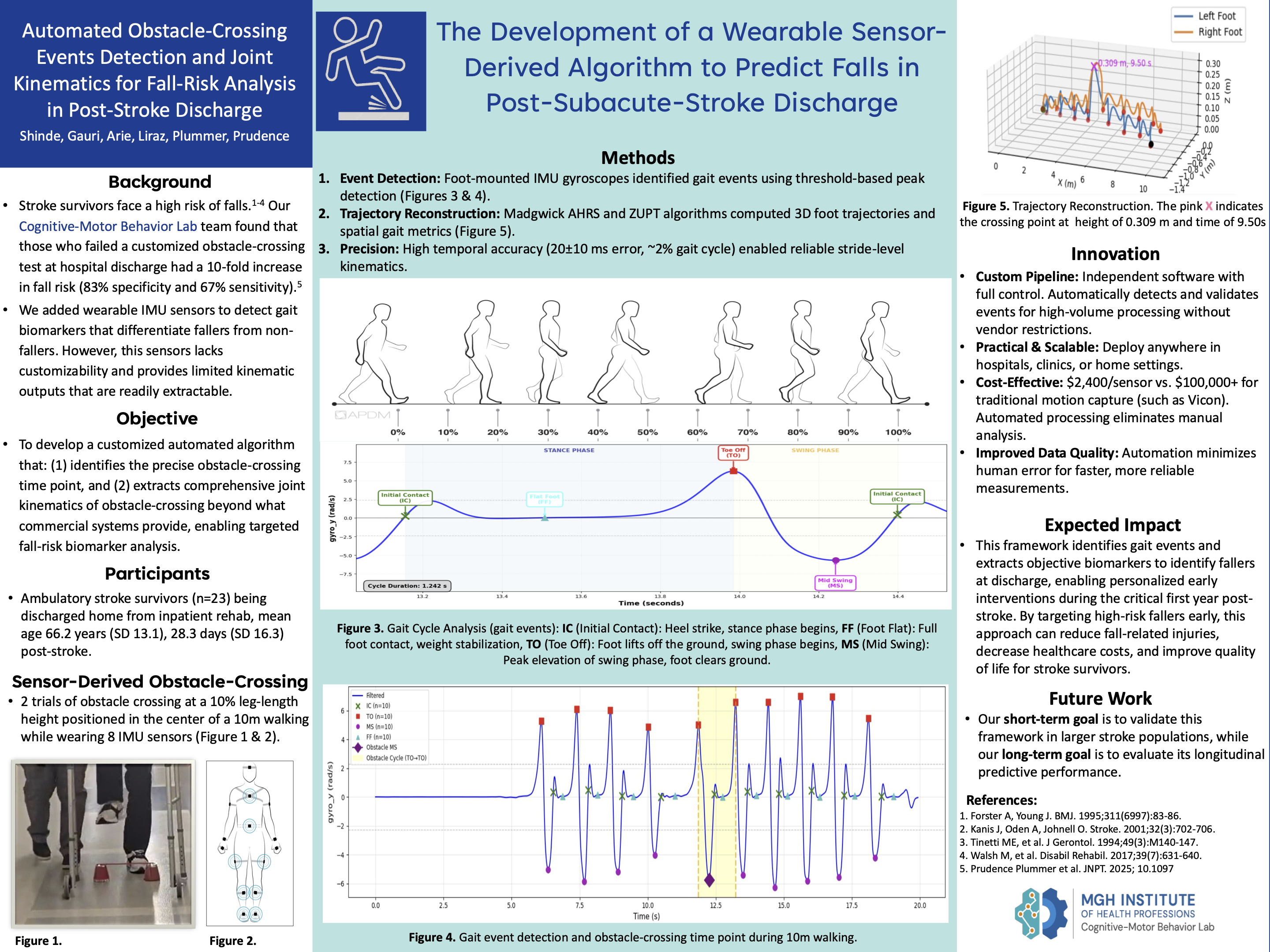
Incidence of post-stroke falls is high shortly after hospital discharge, causing serious injuries and loss of independence. We found that failure on a customized obstacle-crossing test at discharge increased fall risk 10-fold. To improve prediction, we used IMUs capturing spatiotemporal gait parameters and joint motion to detect biomarkers differentiating fallers from non-fallers. To enable identification of these subtle biomarkers, we developed custom automated pipelines incorporating strapdown inertial navigation with zero-velocity updates, error-state Kalman filtering, single-gyroscope gait event detection, and sensor fusion for 3D trajectory reconstruction from extracted kinematic features. This framework provides objective, automated fall risk assessment at care transitions.