
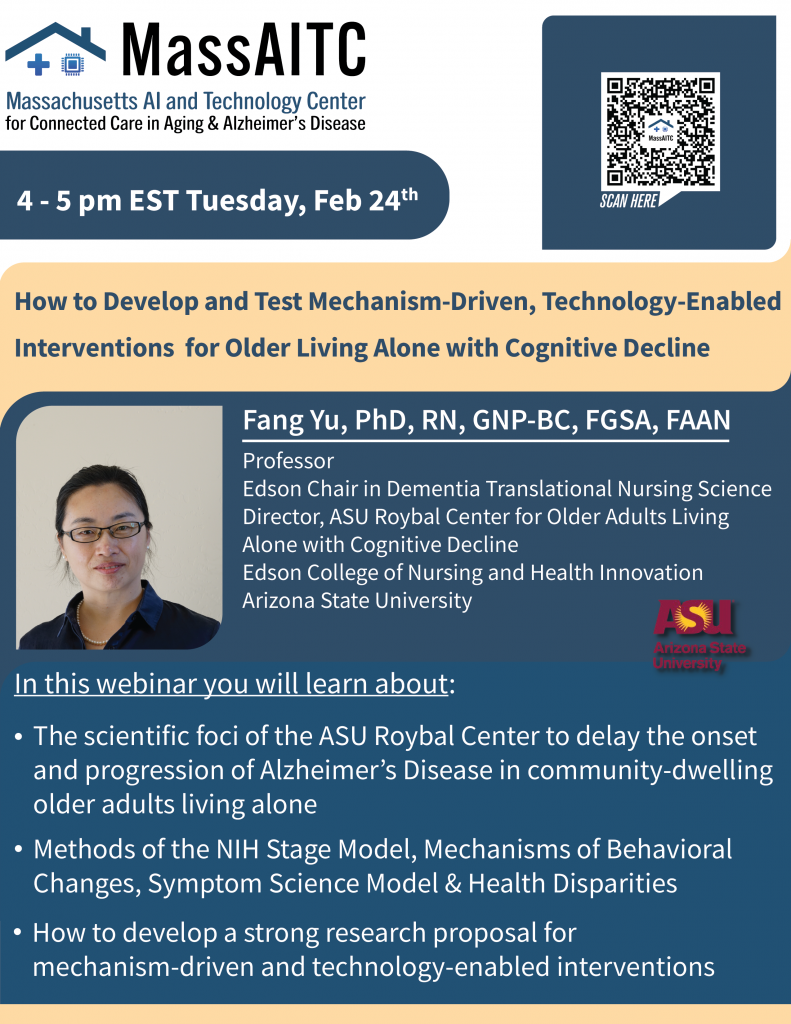
Abstract:
Purpose: 1) Explain the scientific foci of ASU Roybal Center for Older Adults Living Alone with Cognitive Decline to delay the onset and progression of Alzheimer’s disease and related dementia (AD/ADRD), and 2) Guide investigators to develop strong research proposals, focusing on the significance of a proposed solution, mechanism-driven and technology-enabled interventions, and health disparity factors.
Rationale: Poor lifestyle behaviors such as physical inactivity, unhealthy diet, and stress contribute to up to 40-50% of AD/ADRD cases; however, few intervention successes have been translated into real-world impacts. Most interventions are not mechanism-driven, precise, accessible, cost-effective, and/or scalable, which could potentially be addressed by technology through integrating Artificial Intelligence, real-time analytics and feedback, enhancing user autonomy and person-centeredness, and personalizing intervention prescription and delivery. In addition, the population of older adults living alone with cognitive decline, a rapidly growing population, are often left out of AD/ADRD intervention research.
Methods: The scientific foci of ASU Roybal Center is guided by its conceptual framework that integrates the National Institutes of Health (NIH) Stage Model, Mechanisms of Behavioral Changes, Symptom Science Model, and Health Disparities Research Framework.
Results: ASU Roybal Center postulates that technology-enabled interventions that target mechanisms of behavior change (MoBC) or biological pathways will effectively promote healthy behaviors. Trial 1 focuses on social support and stress resilience to increase physical activity in isolated older adults with subjective cognitive decline. Trial 2 focuses on interpersonal/social processes to improve emotional wellbeing for those with early AD living alone. Commons problems observed in proposal submissions to ASU Roybal Center’s Call for Trials include unspecified significance of the proposed solution, under-consideration of the NIH Stage Model, lack of scientific support for the mechanisms of the intervention, unclear intervention dose, treatment fidelity, and adherence, and lack of considerations of critical disparity factors.
Conclusions: Targeting mechanisms of action is critical to promote behavior and lifestyle change. Technology-enabled interventions could accelerate intervention development and testing in a growing but overlooked population—older adults living alone with cognitive decline.
Biography:
- Fang Yu, PhD, RN, GNP-BC, FGSA, FAAN
- Dr. Yu is a Professor, the Edson Chair in Dementia Translational Nursing Science, and the Director of ASU Roybal Center for Older Adults Living Alone with Cognitive Decline at Arizona State University Edson College of Nursing and Health Innovation. Her research focus on exercise and technology-enabled behavioral and lifestyle interventions to prevent Alzheimer’s disease and related dementia and slow their progression. Dr. Yu is a Fellow of the Gerontological Society of the America and the American Academy of Nursing. She was a faculty at the University of Minnesota School of Nursing (2006-2020), held the Long-Term Care Professorship, and was the Chair of the Adult and Gerontological Health Cooperative. She chaired many committees and served as associate editors and grant reviewers.