
Investigators:
Edward Jay Wang, Billion Labs Inc.
MassAITC Cohort: Year 3 (Aging)
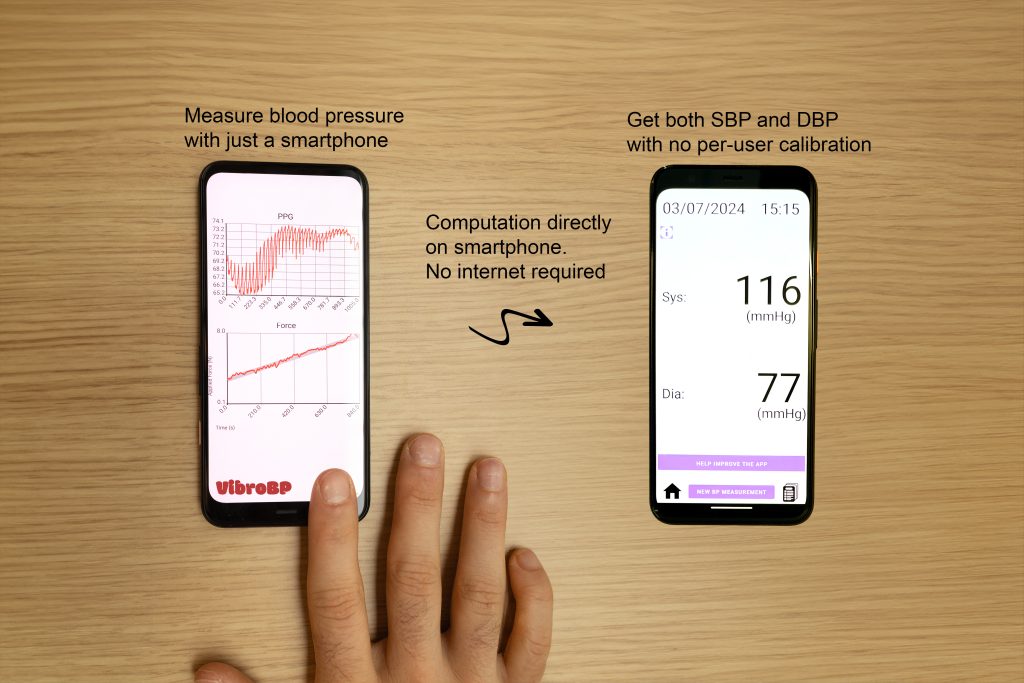
Project Accomplishments: Billion Labs developed VibroBP—a smartphone application that measures blood pressure at the fingertip using oscillometry without requiring any external attachments. The technology uses a novel Smartphone Force Vibrometry (SFV) technique where a user places their finger on the phone’s camera while the screen illumination and camera measure pulse amplitude via photoplethysmography (PPG), and applied pressure is determined by vibrating the phone and analyzing changes in vibration amplitude with the onboard inertial measurement unit (IMU). The project had three aims: developing a cross-model smartphone force vibrometry algorithm (Aim 1), conducting human subject validation with 85 subjects including a naturally hypertensive population (Aim 2), and performing usability assessment with older adults (Aim 3). All aims were successfully achieved, including completion of the 85-subject clinical validation study at UCSD ACTRI and usability studies with 24 participants at Belmont Senior Living and UCSD.
Major breakthroughs during the project included enabling fully handheld measurement (removing the requirement that the phone rest on a table), an iOS sensing breakthrough using an acoustic side channel with a provisional patent filed, and a successful FDA Q-sub meeting that determined the device requires a De Novo regulatory pathway.
Initial Proposal Abstract: Hypertension has long been regarded as a key marker for screening towards healthy aging, being a key risk factor for cardiovascular diseases such as strokes and heart failure.Also, hypertension is more recently established as a risk factor for cognitive impairments. Currently, an estimated 46% of the 1.28 billion adults with hypertension are unaware of hypertensive condition and not seeking treatment. Diagnosing the nearly 500 million adults unaware of their hypertensive condition is an imperative first step towards addressing this crisis. This proposal aims to establish accessible early screening of hypertension by democratizing BP monitoring. We aim to achieve this by converting the billions of smartphones, focusing on the cheapest models, into oscillometric BP monitors without no hardware add-ons.
Our solution, VibroBP, performs BP measurement using a technique called oscillometry, which is the same underlying technology used in upper-arm cuff devices. To measure BP, two key measurements are required: (1) the PRESSURE applied to the artery and (2) the AMPLITUDE of the pulse in the artery being measured. Our system, called VibroBP, captures these two measurements in the following way. A user places their finger over the front facing camera while the phone is resting on a flat surface. The screen illuminates the finger while the camera measures the amplitude of the pulse through the use of photoplethysmogram (PPG). The novel insight that underly our proposed solution is a technique called Smartphone Vibrometric Force Estimation (VFE). VFE is based on a simple concept that a vibrating object will dampen when force is applied to it. By vibrating a phone with its internal vibration motor, our app can measure the force being applied by a user’s finger by measuring the vibration amplitude with the on-board inertial measurement unit (IMU). By measuring the force applied in real-time, the app guides the user to press in increasing pressure, until the pulse is cut off, which is measured by the camera. Finally, the pressure and pulse amplitude profile are converted to a BP oscillogram, which is used to calculate SBP/DBP.
In this pilot study, we aim to develop, validate, and refine our VibroBP solution through a series of user testing. Further, we plan to work closely with older adults to ensure our proposed solution works well for geriatric use. Through the success of this pilot, our goal is to pursue regulatory clearance of the VibroBP app for over-the-counter distribution for mass consumer use.
Outcomes:
- Award: Best Demo Audience Choice Award at IEEE BSN 2025
 The team of Colin Barry, Tatsuo Kumamoto, Edward Wang, and Lina Battikha won the Audience Choice Award for Best Demo at the IEEE-EMBS International Conference on Body Sensor Networks – Computational Medicine: Expanding Health through Sensing and AI held from November 3-5, 2025 for their demo entitled, “Oscillometric Smartphone Blood… Read more: Award: Best Demo Audience Choice Award at IEEE BSN 2025
 - Award: Best Demo at eWEAR Health Prize at Stanford UniversityOn Thursday October 30, 2025, Billion Labs Inc. was voted Best Demo by the audience at the Start-up demo showcase as part of an event put on by the Stanford Wearable Electronics Initiative (eWEAR). Source: LinkedIn Post
- Poster Presentation: a2 National Symposium 2025
 Title: VibroBP: Calibrationless Smartphone BP Monitoring using Vibrometric Force Estimation Authors: Colin Barry, Tatsuo Kumamoto, Yinan Xuan, Ava Fascetti, Amparo Averbuj, Edward J Wang
 - Grant Funding: NIH Trailblazer Award
 This is an R21 award for $650,000 over a period of 3 years. Their smartphone app prototype capitalizes on the handheld nature of a mobile phone and uses its built-in sensors to gauge grip strength to enhance preoperative screening for potential risks of complications post cardiac surgery. This effort will… Read more: Grant Funding: NIH Trailblazer Award
 - Publication: Oscillometric blood pressure measurements on smartphones using vibrometric force estimation
 Authors: Colin Barry, Yinan Xuan, Ava Fascetti, Alison Moore, Edward J Wang Abstract This paper proposes a smartphone-based method for measuring Blood Pressure (BP) using the oscillometric method. For oscillometry, it is necessary to measure (1) the pressure applied to the artery and (2) the local blood volume change. This… Read more: Publication: Oscillometric blood pressure measurements on smartphones using vibrometric force estimation
 - Publication: Development of a One Dollar Blood Pressure MonitorAuthors: Yinan Xuan, Ava J. Fascetti, Colin Barry, Edward J. Wang Abstract BPClip is an ultra-low-cost cuffless blood pressure monitor. As a universal smartphone attachment, BPClip leverages the computational imaging power of smartphones to perform oscillometry based blood pressure measurements. This paper examines different design considerations in BPClip’s development. The… Read more: Publication: Development of a One Dollar Blood Pressure Monitor
- Award: Don Norman Design Award 2024 – Special RecognitionBillion Labs Inc was honored with a DNDA24 Special Recognition for “Reducing Barrier to Access Hypertension Screening Globally.” What they said: Billion Labs Inc. is a startup company whose mission is to transform the billions of smartphones in everyone’s pocket to screen for critical health conditions like all-cause mortality, hypertension,… Read more: Award: Don Norman Design Award 2024 – Special Recognition
- Grant Funding: 2024 Innovation Award Competition: Center for Advancing Point of Care Technologies in Heart, Lung, Blood and Sleep Disorders (CAPCaT)Billion Labs Inc is a recipient of the 2024 CAPCaT Innovation Award to further advance the design of the user interface for their VibroBP smartphone app for measuring blood pressure. The award covers $100,000 in direct costs for the 12-month long project. The CAPCaT is a partnership between UMass Chan… Read more: Grant Funding: 2024 Innovation Award Competition: Center for Advancing Point of Care Technologies in Heart, Lung, Blood and Sleep Disorders (CAPCaT)
- New Hire: Full-time Software Engineer
 Funding from the pilot award enabled Billion Labs Inc. to hire a full-time software engineer, Tatsuo Kumamoto. Source: Tatsuo Kumamoto (LinkedIn)
 - Patent: PCT filed for VibroBP
 PCT filed for VibroBP: U.S. Provisional Application No. 63/385,383 – Colin Barry et al. – Mobile Device Based Oscillometric Blood Pressure Measurement [SD2023-139-1; 009062-8487.WO00]