Abstract:
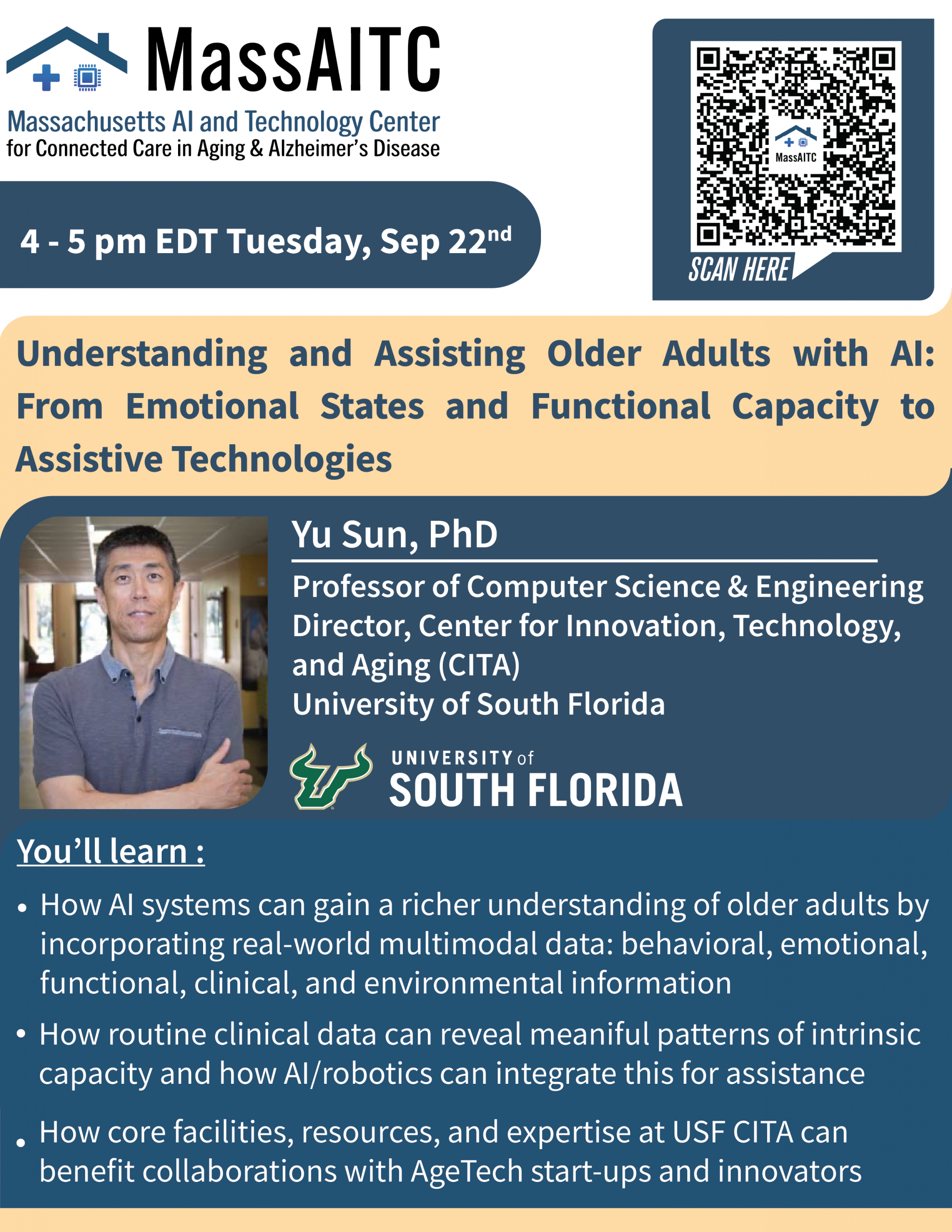
Older adults’ needs and abilities are multidimensional and continuously changing, yet much of today’s AI focuses on detecting isolated events or predicting individual outcomes. Our work explores how AI can develop a richer understanding of older adults by integrating behavioral, emotional, functional, clinical, and environmental information. We investigate how subtle changes in emotional state can be inferred from multimodal behavior, how routinely collected clinical data can reveal meaningful patterns of intrinsic capacity, and how AI and robotics can translate this understanding into practical assistance. Across these efforts, we are also developing the data integration and validation infrastructure needed to make AI systems reliable, generalizable, and useful in real-world aging settings. Ultimately, our goal is to move from AI that simply observes older adults to AI that understands their changing needs and abilities and helps them live more independently and with greater support.
Biography:
- Yu Sun, PhD
- Yu Sun is a Professor in the Bellini College of AI, Cybersecurity and Computing and Director of the Center for Innovation, Technology, and Aging (CITA) at the University of South Florida. He received his Ph.D. in Computer Science from the University of Utah in 2007, followed by postdoctoral research at Mitsubishi Electric Research Laboratories in Cambridge, Massachusetts, and the University of Utah.
His research spans artificial intelligence, robotics, computer vision, and healthcare, with a particular focus on developing AI technologies that can understand and assist people in the most vulnerable stages of life. As Director of CITA, he leads an interdisciplinary effort to develop and translate technologies that address challenges in aging and care. His research has resulted in numerous publications and 15 U.S. patents, spanning robotics, multimodal AI, computer vision, and healthcare technologies. He has held editorial and leadership roles across major robotics journals and conferences. He is a recipient of the 2018 USF Excellence in Innovation Award, and his research has been supported by NIH, NSF, ARPA-H, and the U.S. Army.
- Yu Sun is a Professor in the Bellini College of AI, Cybersecurity and Computing and Director of the Center for Innovation, Technology, and Aging (CITA) at the University of South Florida. He received his Ph.D. in Computer Science from the University of Utah in 2007, followed by postdoctoral research at Mitsubishi Electric Research Laboratories in Cambridge, Massachusetts, and the University of Utah.