
Registration: https://tinyurl.com/MassAITC-Oct2026-webinar
Abstract:
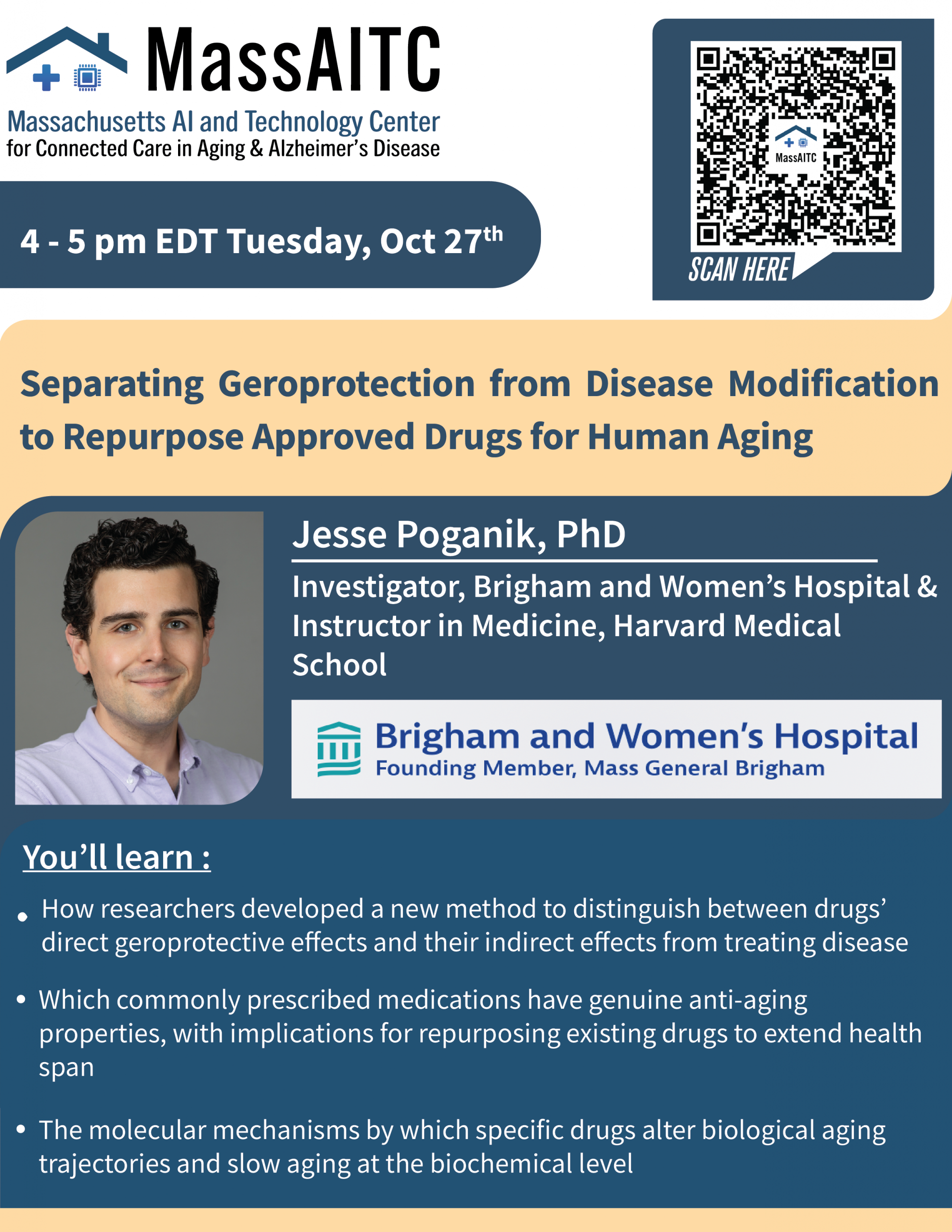
Identifying drugs that slow biological aging in humans is a central goal of geroscience, but a key confounder in observational studies is that drugs prescribed for serious conditions may lower biological age scores indirectly by reducing disease burden rather than by exerting a direct geroprotective effect. To address this, we developed an analytical framework that incorporates indication-specific covariates, isolating drug-associated changes in biological age that are independent of disease modification. Applying this approach across large data resources, we systematically evaluate approved medications for geroprotective activity, and further interrogate top candidates using high-dimensional plasma proteomics and metabolomics to gain mechanistic insight into how these drugs alter aging trajectories. This framework provides a scalable strategy for identifying approved, commonly prescribed drugs with geroprotective properties, with broad implications for translating aging biology into actionable clinical interventions.
Biography:
- Jesse Poganik, PhD
- Dr. Jesse Poganik is an Investigator at Brigham and Women’s Hospital and Instructor in Medicine at Harvard Medical School. His laboratory applies aging biology as a lens to understand pressing clinical challenges, with a particular focus on aging biomarkers, their plasticity, and translating these insights into interventions that promote healthy aging. Dr. Poganik also serves as co-director of the Biomarkers of Aging Consortium, a collaborative initiative spanning institutions across the world.